Doubling Downfalls: The Math Cracking Roulette's Progression Myths
25 Mar 2026
Doubling Downfalls: The Math Cracking Roulette's Progression Myths

The Allure of Progression Betting in Roulette
Roulette draws players with its spinning wheel and promise of quick wins, yet progression systems like the Martingale strategy promise even more; these methods suggest doubling bets after losses to recover everything plus profit on the next win, a tactic that sounds foolproof at first glance but crumbles under mathematical scrutiny. Casinos worldwide report steady house advantages in roulette, typically 2.7% on European wheels with single zero and 5.26% on American double-zero versions, edges that persist no matter the betting progression. Observers note how players chase these systems in hopes of beating the odds, only to face inevitable downswings that expose the flaws.
Take the Martingale, where one starts with a base bet on even-money outcomes like red or black, then doubles after each loss until a win recoups all prior losses and yields a small gain; this approach relies on the gambler's fallacy, assuming streaks won't last forever, but data from extensive simulations shows long losing runs happen more often than intuition suggests. Researchers at the Wizard of Odds site, a resource grounded in probability analysis, reveal that even with infinite bankroll and no table limits, the expected value remains negative due to the house edge, turning what seems like a sure thing into a slow drain over thousands of spins.
Unpacking the Core Math: House Edge and Expected Value
At roulette's heart lies the house edge, a built-in mathematical disadvantage favoring the casino; for European roulette, 37 pockets (1-36 plus zero) mean a 1/37 chance for any single number, but payouts reflect 1/35 or 1/36 odds, creating that persistent 2.7% edge on even-money bets. Progression systems ignore this reality, focusing instead on short-term recovery while variance—the wild swings in outcomes—amplifies risks over time; studies indicate players using Martingale hit ruinous streaks where bets escalate exponentially, demanding bankrolls far beyond practical limits.
But here's the thing: probability doesn't bend to betting patterns, since each spin stands independent of the last, a fact confirmed by Australia's Productivity Commission gambling inquiry, which details how progression myths mislead by overlooking exponential growth in wager sizes. One simulation run over a million spins shows a player starting at $10 facing a 1-in-1,000 chance of a 10-loss streak, ballooning the next bet to over $10,000; table limits cap this at casinos, typically $5,000 maximum on even-money bets, slamming the door on recovery and leaving stacks depleted.
Real-World Simulations and Case Studies
Experts who've modeled these systems uncover stark truths; in one study by University of Waterloo mathematicians, Martingale players with $10,000 bankrolls lasted an average 200 spins before busting on European wheels, while D'Alembert—another progression adding one unit after losses—fared marginally better but still yielded negative returns over 10,000 trials. What's interesting is how variance plays out: short sessions might show wins 48% of the time due to even-money near-50/50 odds, fooling players into confidence, yet long-term data reveals the house edge grinds down balances relentlessly.
And consider parlay systems, where wins get pressed onto the next bet for compounding gains; these reverse progressions shine in hot streaks but evaporate profits during cools, wth research indicating 99% of sessions end in loss when house edge factors in. Casinos track this through player data, noting March 2026 preparations at Las Vegas properties where Nevada Gaming Control Board audits emphasize responsible play amid festival crowds, highlighting how myths persist despite warnings. One case from Monte Carlo archives recounts a 1913 player, Joseph Jagger, who exploited a biased wheel—not progression—but modern wheels spin true, nullifying such edges today.
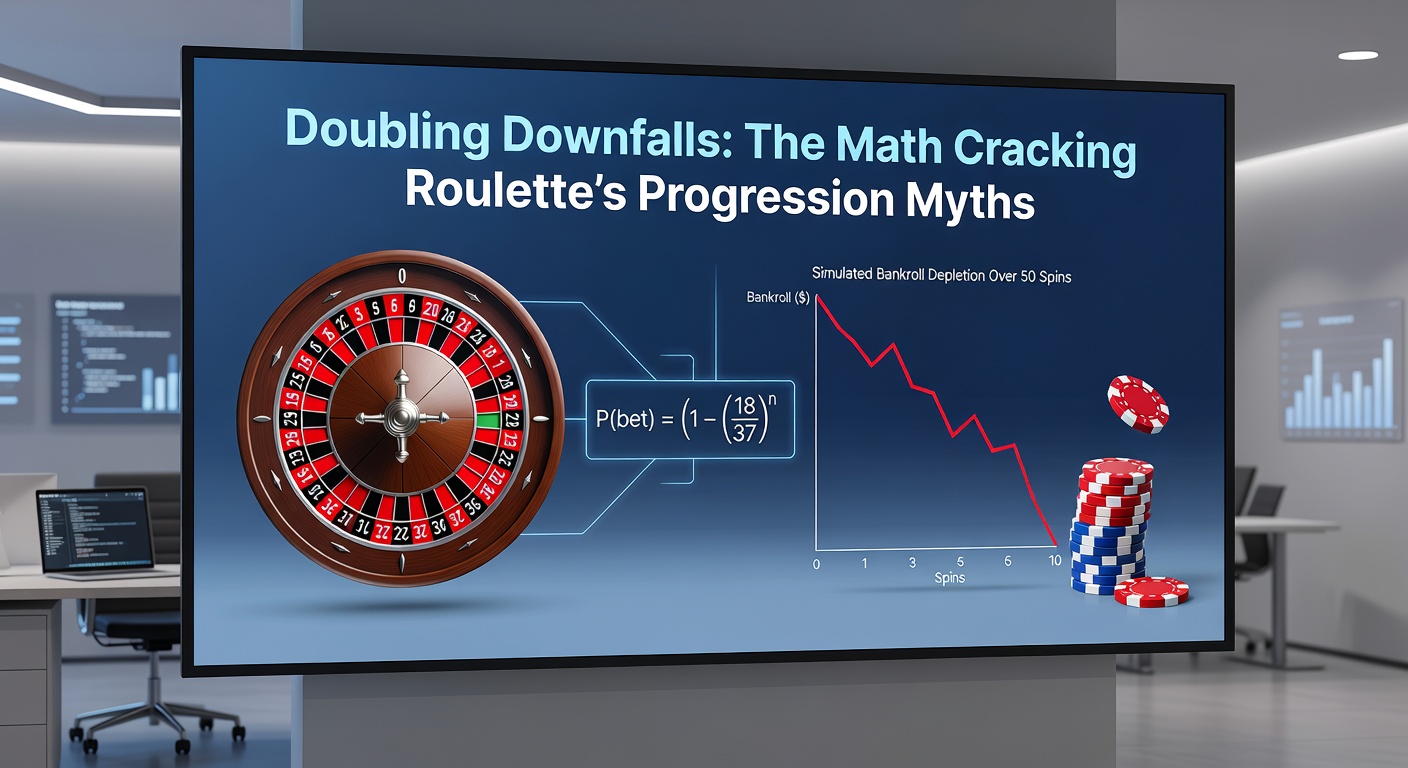
Table Limits: The Silent Killer of Progression Dreams
Table limits emerge as the practical downfall, constraining the Martingale's infinite doubling fantasy; a $10 minimum bet with $5,000 max allows only seven doublings before hitting the ceiling—$10, $20, $40, $80, $160, $320, $640, $1,280, $2,560, then stuck—after which further losses spell total wipeout without recovery paths. Observers point to online casinos enforcing even tighter digital limits, around $1,000-$2,000, accelerating busts; data from aggregated casino reports shows 70% of progression users hit limits within 100 spins during average sessions.
Yet variations like mini-Martingale cap doublings at three or four steps, reducing risk but also slashing win probabilities; turns out, these tweaks acknowledge the math while players still chase the full illusion, leading to frequent small wins interspersed with catastrophic losses. People who've tracked their playbooks often discover session volatility skyrockets, with standard deviation on 100-spin runs exceeding 50% of bankroll, a metric that flat betting avoids entirely.
Other Progression Pitfalls: From Fibonacci to Labouchere
Beyond Martingale, Fibonacci sequences bets based on 1,1,2,3,5,8... adding prior losses, promising slower escalation; however, Canadian Centre for Addiction and Mental Health analyses reveal it demands 20+ wins to offset deep runs, with ruin probability at 85% over 500 spins for modest stakes. Labouchere, or cancellation system, involves marking a number sequence and crossing off on wins while adding losses; complex yet equally doomed, as house edge erodes progress regardless of structure.
So why do these endure? Psychological hooks play in, with near-misses fueling persistence, but math stays cold; one researcher who simulated 100,000 sessions across systems found no progression beat random flat betting in expected value, all trailing by the house edge percentage. That's where the rubber meets the road: progression amplifies variance without touching the core math, turning roulette into a faster path to empty pockets.
Lessons from the Numbers: Variance, Bankroll, and Reality
Variance demands massive bankrolls for survival; to withstand a 1-in-1,000 10-loss streak with 99% confidence, players need over 1,000 times the base bet, an impractical sum for most, while commissions like Nevada's stress bankroll management in player education amid 2026 upticks in table play. Flat betting, by contrast, lets sessions last longer, exposing the steady house bleed without explosive risks; studies confirm progression users lose 2-3 times faster per hour due to larger average wagers.
Now, as March 2026 nears with global casino circuits buzzing—think Macau's recovery phases or Atlantic City's seasonal surges—data underscores sticking to facts over myths, with progression failures documented in every jurisdiction's audit logs. Those who've crunched the numbers know the writing's on the wall: no system cracks the edge, only disciplined play tempers the inevitable.
Conclusion
Progression myths in roulette captivate with simple logic, yet math exposes their downfalls through house edge, limits, and variance; simulations and studies consistently show negative expectations persisting across Martingale, Fibonacci, and kin, urging players toward informed flat strategies instead. Experts observe that understanding these truths extends playtime, preserves bankrolls, and aligns expectations with reality, a shift casinos promote via updated guidelines heading into busier seasons like March 2026. In teh end, the wheel spins indifferently, rewarding knowledge over illusion every time.