15 Jul 2026
Database Analysis for Sharpening Multiway Pot Choices in Texas Hold'em

Hand history databases store detailed records of every action taken during Texas Hold'em sessions, and players have turned to these archives to sharpen decisions when three or more opponents contest the same pot. Software platforms capture betting sequences, position data, stack sizes, and board textures, which researchers and serious players then query to identify repeatable patterns. Studies from institutions such as the University of Alberta demonstrate how aggregated data sets improve range construction when multiple opponents remain involved postflop.
Core Components of Modern Hand History Systems
Contemporary databases collect information through hand-import features built into major poker clients, and they organize each hand into searchable fields that include hole cards shown at showdown, continuation-bet frequencies, and fold-to-three-bet rates. Analysts filter these fields by number of players who saw the flop, allowing queries that isolate multiway scenarios specifically. Tools developed in recent years add filters for stack-to-pot ratios and effective stack depths, because those variables change optimal calling ranges when three or more players see the turn and river.
Applying Filters to Isolate Multiway Tendencies
Users begin by selecting hands where at least three players contributed to the pot on the flop, then they layer additional constraints such as position and prior action. One common query examines how often the big blind defends versus a raise when two or more players have already entered the pot. Another tracks river betting frequencies after the pot has been checked through on the turn in four-way situations. Data sets compiled from online rooms and live tournaments show that continuation-bet success rates drop markedly once three or more opponents remain, yet precise percentages vary by board texture and position.
Key Metrics That Influence Multiway Strategy
Researchers track several statistics that gain relevance only when multiple players contest the pot. These include:
- Fold-to-flop-continuation-bet percentage broken down by number of callers
- Check-raise frequency on coordinated boards when the pot is three-way or larger
- River calling ranges versus single bets after two or more opponents checked the turn
- Showdown winning percentages when the initial raiser faces two or more defenders
Each metric gains statistical significance only after thousands of hands have been logged, which is why serious players maintain large personal databases or subscribe to aggregated services that pool anonymized data from many users.
Software Platforms and Query Techniques
Programs such as Hold'em Manager and PokerTracker allow users to build custom reports that automatically calculate equity-adjusted expected value for different lines in multiway spots. Filters can be combined with equity calculators that simulate ranges against multiple opponents simultaneously. In July 2026 several platforms released updates that integrate real-time equity visualizations for four-way and five-way pots, reducing the time required to review sessions after each playing period. Users import hands directly from major sites, and the software tags every action with positional data that later supports precise multiway queries.
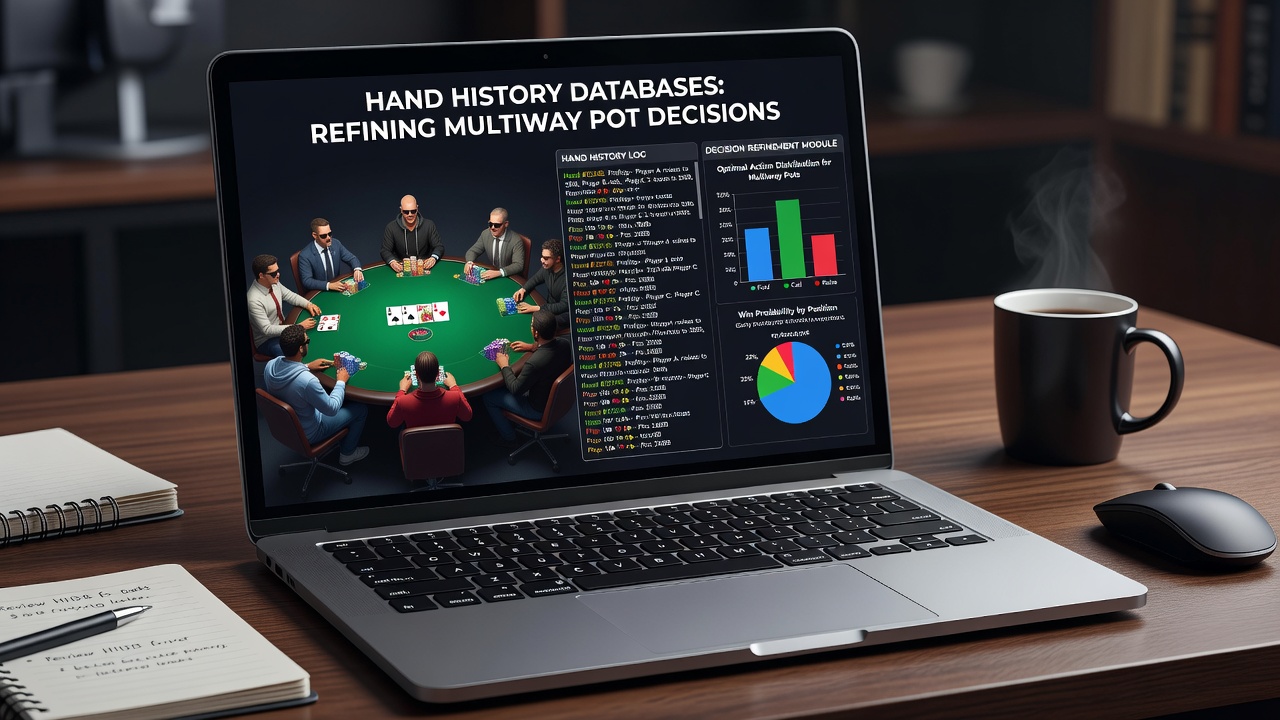
Advanced users export filtered hand sets into external spreadsheets or statistical packages. They calculate frequencies such as the rate at which middle-position players continuation bet into three opponents after raising preflop. These calculations reveal whether a given population over-folds or over-calls in specific board categories, information that directly shapes future betting decisions.
Case Examples from Aggregated Data Sets
One analysis of more than 2.3 million multiway hands revealed that flop continuation bets succeed only 38 percent of the time when three players see the flop on monotone boards, whereas the same bet succeeds 61 percent of the time on rainbow disconnected boards. Another study tracked turn-leading frequencies after a checked flop in four-way pots and found that leading ranges become polarized once the pot reaches a certain size relative to remaining stacks. Observers note that players who adjust their ranges according to these database-derived frequencies show measurable improvements in return on investment over large sample sizes.
Live-game players have begun importing hand histories from video recordings and tournament reports to build comparable databases. Although sample sizes remain smaller than online collections, the same filtering principles apply and produce actionable adjustments for tournament stages where multiway pots occur frequently.
Limitations and Data-Quality Considerations
Hand history databases rely on accurate card reporting and complete action logging, yet some sites omit certain information or present hands in formats that require manual correction. Small sample sizes in specific subcategories, such as five-way pots on paired boards, can produce misleading frequencies until additional hands accumulate. Players therefore combine database insights with fundamental poker theory rather than treating raw numbers as absolute rules. Cross-verification across multiple data sources reduces the risk of drawing conclusions from biased or incomplete records.
Conclusion
Hand history databases supply concrete frequencies that help refine decision making whenever three or more players contest a Texas Hold'em pot. By organizing large numbers of recorded hands into searchable fields, these systems allow precise queries that isolate multiway tendencies and board-specific adjustments. Software updates scheduled for mid-2026 continue to streamline the review process, while established research institutions maintain public data sets that further support analytical work. Players who systematically apply the resulting statistics to their range construction and betting patterns obtain measurable edges that compound across thousands of hands.