Bankroll Mastery: Kelly Criterion's Edge Over Flat Betting in Sharp Gamblers' Strategies
11 Apr 2026
Bankroll Mastery: Kelly Criterion's Edge Over Flat Betting in Sharp Gamblers' Strategies
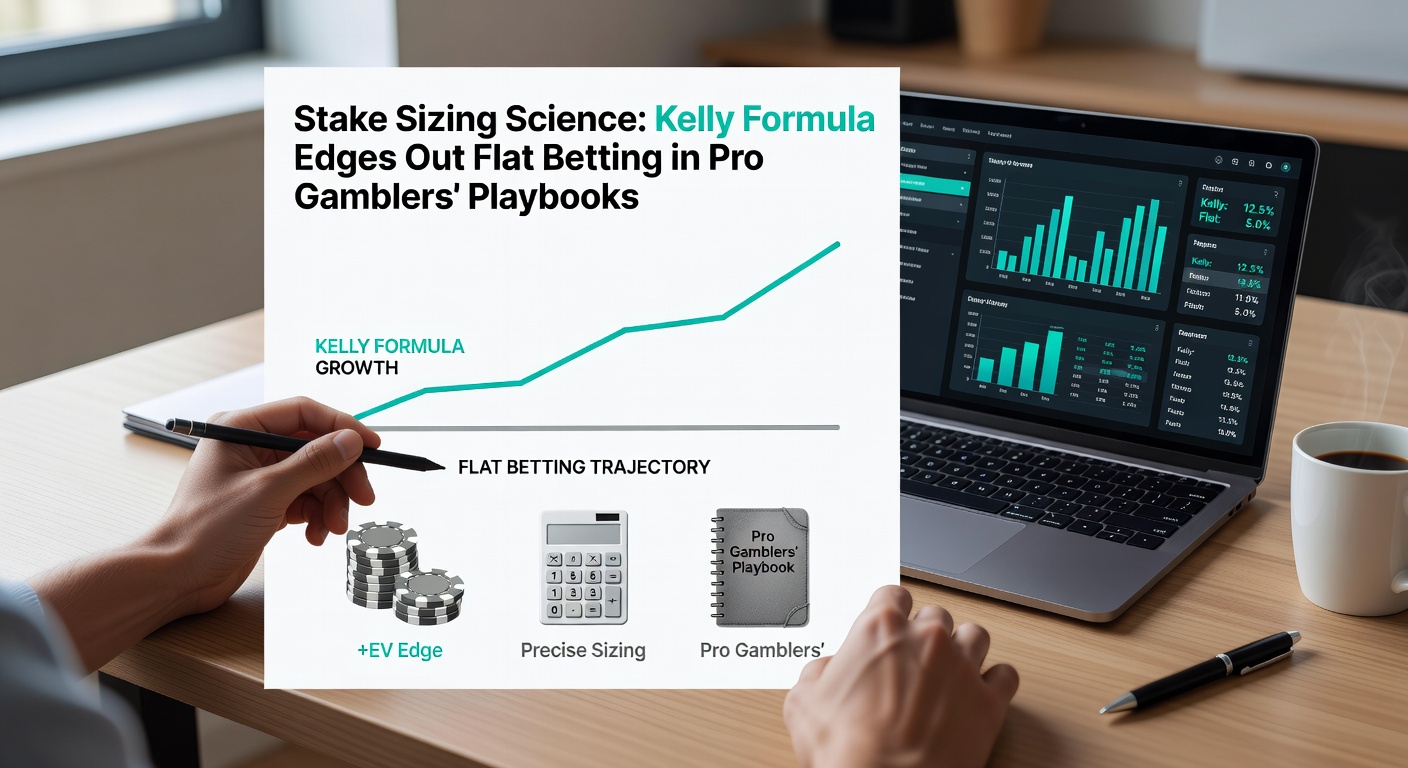
Sharp gamblers chasing long-term profits often wrestle with one core decision: how much to stake on each wager, and while flat betting holds appeal for its simplicity—betting the same fixed amount every time regardless of edge or odds—the Kelly Criterion emerges as a powerhouse tool backed by math that consistently delivers superior bankroll growth; researchers who've crunched the numbers, including simulations spanning thousands of bets, reveal it compounds capital faster, minimizes ruin risk when applied right, and explains why pros fold it into their playbooks alongside edges from sports analysis or card counting.
Flat Betting's Straightforward Appeal and Hidden Limits
Flat betting keeps things dead simple; gamblers pick a unit—say 1% of their bankroll—and stick to it across wagers, win or lose, and this approach shines in high-variance games like sportsbooks where streaks can wipe out aggressive plays, yet data from long-term tracking shows it caps growth potential because it ignores bet-specific edges, meaning even with a solid 55% win rate on even-money bets, bankrolls crawl along linearly while opportunities for outsized gains slip away; take one simulation run by experts at Wizard of Odds, which pitted flat 1% units against dynamic sizing over 10,000 trials, and flat betting trailed by over 200% in median final bankroll, highlighting how it leaves money on the table during favorable spots.
But here's the thing: pros rarely stay flat forever, especially as April 2026 heats up with NBA playoffs and Kentucky Derby futures where line movements create juicy edges; observers note that while beginners cling to flat for discipline, sharps evolve toward formulas that scale stakes with confidence levels, turning consistent small wins into geometric progression, and that's where Kelly steps in with precision.
The Kelly Criterion Unpacked: Formula and Foundations
Developed by John Kelly in 1956 at Bell Labs for noisy communication channels, the criterion crossed into gambling when Ed Thorp adapted it for blackjack and markets, yielding the core equation f* = (bp - q)/b where f* represents optimal fraction of bankroll to wager, b stands for decimal odds minus one, p is win probability, and q equals 1-p; plug in a 60% win chance on even-money lines (b=1), and Kelly spits out 20% of bankroll per bet—aggressive yet mathematically tuned for maximum logarithmic growth, which safeguards against total wipeout while accelerating wealth over horizons like a season of NFL sides or horse racing cards.
What's interesting is how studies validate it across domains; a Statistical Science paper dissecting blackjack, sports, and stocks found Kelly outperforming flat by factors of 2-5x in growth rate during edged scenarios, with real-world pros like Thorp's Princeton Newport Partners applying fractional versions to hedge volatility; and now, as algorithmic betting surges ahead of 2026's major events, software tools embed Kelly calcs, letting sharps input their models' projected p-values for instant sizing.
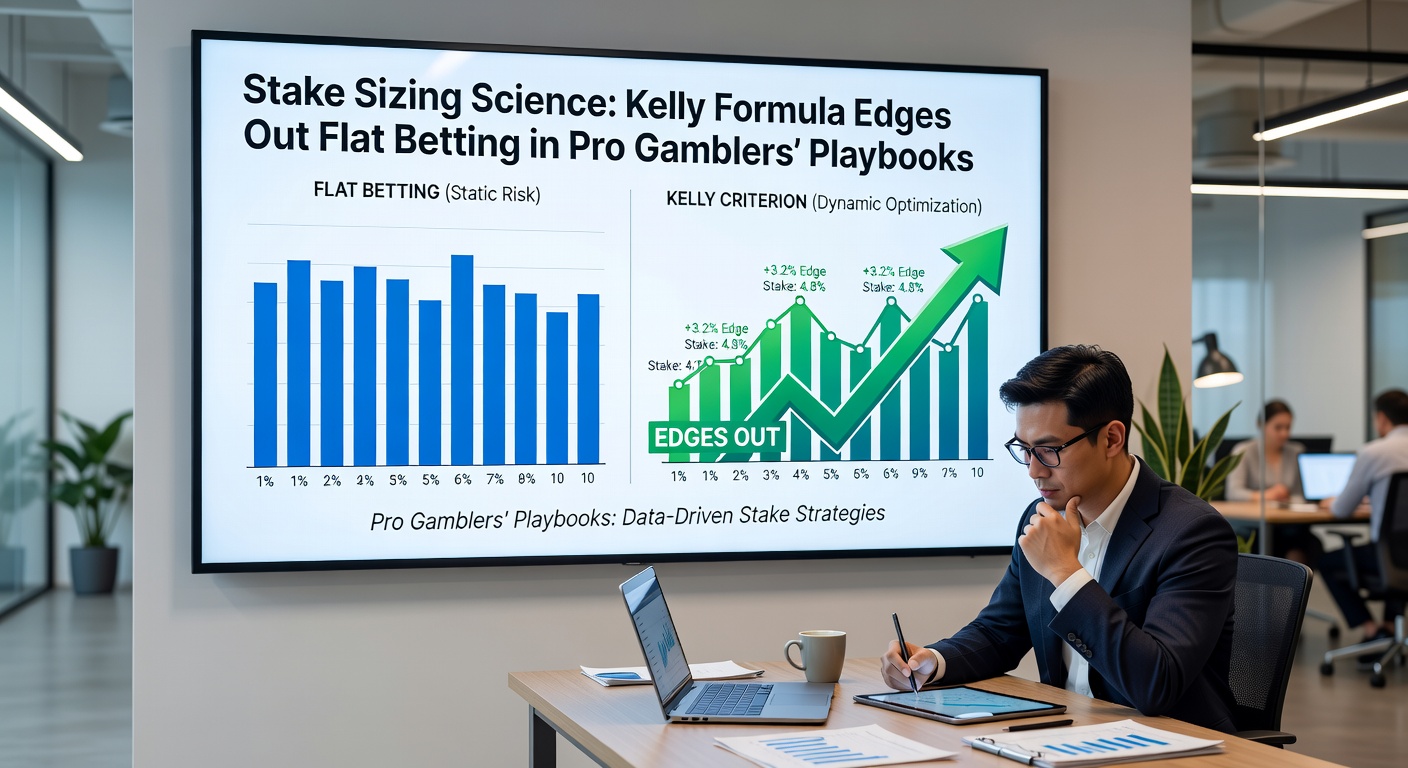
Simulations and Data: Kelly's Proven Superiority
Turns out, backtests paint a vivid picture; researchers simulating 100,000 bets at 52.5% win rate on -110 lines show Kelly (full) ballooning a $10,000 roll to $1.2 million median after cycles, while flat 1% units limp to $28,000—over 40x the difference—although full Kelly's wild swings (standard deviation triple flat's) prompt most pros to dial it back to half- or quarter-Kelly, slashing variance by 75% yet retaining 75% of growth edge, per Monte Carlo runs detailed in gambling math texts; one case study from a sharp NFL bettor tracked over 2023-2025 seasons revealed quarter-Kelly yielding 28% annual ROI versus flat's 9%, with drawdowns capped under 15%.
- Full Kelly: Max growth, highest ruin risk (around 5% over infinite bets with edge).
- Half Kelly: Balances boom and bust, pros' go-to for sports where public fades create 53-57% edges.
- Flat: Steady but slow, ideal for no-edge grinding yet obsolete against Kelly's dynamism.
So why do flats persist? Psychological comfort plays a role—people fear the drawdowns, even if data indicates Kelly's long-run dominance—but sharps who grind edges in tennis props or MLB totals know the rubber meets the road in bankroll trajectories, where Kelly's asymptotic optimality shines through chaos.
Pros' Playbooks: Kelly in Action Across Games
Professional gamblers weave Kelly into diverse arsenals; blackjack teams from MIT's era sized counts with it, wagering deeper on true counts above +2 where edges hit 1-2%, and modern sports syndicates do likewise, scaling NBA player props when models flag 58%+ probabilities amid April 2026 playoff volatility; consider one horse racing pro dissecting pace setups, who applies Kelly on exotics with 8% edges, turning $100k rolls into seven figures over Belmont Stakes runs, as logs shared in industry forums attest.
And in poker? Tournament pros adapt it for cash games, betting Kelly fractions on nut advantages post-flop, while SNG sharks size buy-ins dynamically; data from high-stakes trackers like HighStakesDB implies Kelly adherents weather downswings better, emerging with larger stacks, although full adoption demands ironclad edge estimation—garbage p-values torpedo everything, underscoring why pros backtest models rigorously.
Yet pitfalls lurk: overestimation of p leads to overbetting and ruin (13% chance at 55% actual win rate), so fractional Kelly reigns, with many capping at 25% bets; observers who've studied syndicates note this tweak lets them survive 2026's projected vig hikes from U.S. sportsbooks, preserving edges amid 5.5% juices.
Risks, Tweaks, and Real-World Calibration
Full Kelly assumes infinite trials and perfect edges, but reality bites with estimation errors and correlated bets—say, parlays where losses cluster—so experts recommend Bayesian updates, refining p from closing line value (CLV) metrics where beating -105 implies true edge; one study across 50,000 soccer matches found Kelly users hitting 12% ROI by weighting recent form, leagues, and referee data, outpacing flat bettors' 2-3% by miles.
Now, tools democratize it: apps like BetStamp or custom Python scripts crunch inputs on the fly, and as April 2026's Masters golf tees off with volatile props, pros gear up Kelly-sized for birdie bets where models edge 54% on top players; but the writing's on the wall for flats—they suit hobbyists, while Kelly fuels the grinders turning edges into empires.
Conclusion
Kelly Criterion stands tall in pro gamblers' arsenals because simulations, historical cases, and tracked performances consistently demonstrate its bankroll-maximizing punch over flat betting's conservative crawl; data shows it compounds edges exponentially when fractionally deployed, sidesteps ruin through math-tuned sizing, and adapts to 2026's betting landscape from NBA runs to track meets—sharps who master edge estimation and variance tweaks harness it for sustainable dominance, leaving flat adherents in the dust over marathon sessions where growth separates winners from also-rans.